Torrumbarry Weir sits right alongside the park, and it's not just scenery. The lock and weir here went in during the 1920s to manage water levels for irrigation along this stretch of the Murray, and it's part of the same river-management story that runs all the way up to Echuca, roughly the same waterway PS Adelaide has worked since the 1860s.
A fair few guests staying at Torrumbarry Weir Holiday Park use us as a base for a day up the river at the historic port. It's a straightforward drive along the Murray, and you're back at your site well before dark, with plenty of the afternoon still free.
Echuca takes its name from a Yorta Yorta word usually translated as 'meeting of the waters,' for the point where the Murray, Campaspe and Goulburn rivers come together nearby. That junction is a big part of why a port made sense here in the first place, long before Hopwood arrived with his punt.
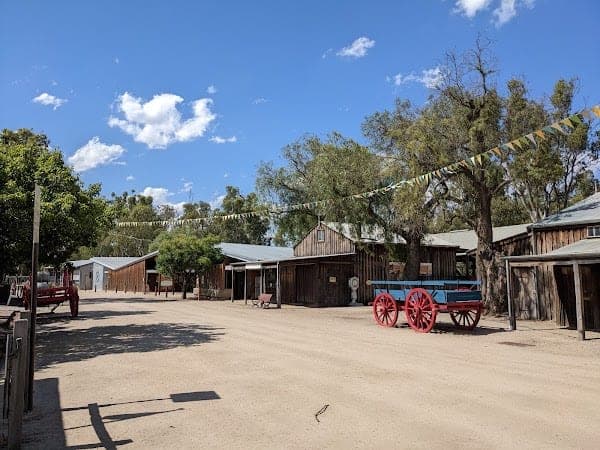
The Port of Echuca Discovery Centre Torrumbarry Weir crowd includes plenty of families filling a rainy day and plenty of grey nomads chasing the paddle steamer history they remember from school. Either way, there's enough packed into the old wharf precinct to fill half a day without rushing. At its peak in the 1870s, Echuca is generally reckoned to have been the busiest inland port in the colony of Victoria, second only to Melbourne for river and rail tonnage combined.
The wharf that anchors the whole precinct was built in 1865, and it's stepped in three tiers of red gum timber rather than sitting flat like an ordinary jetty. The Murray could rise and fall by metres between seasons back then, so a fixed platform simply wouldn't have worked. Wool, wheat and timber all crossed those levels on their way to steamers bound up and down river.
PS Adelaide is the one most people come to see. Built in 1866 and moored at the wharf, she's the oldest wooden-hulled paddle steamer still operating anywhere in the world, and she still takes visitors out on short cruises rather than sitting still as a display piece. She was built using red gum milled from forests along this stretch of the river, the same species that lines the banks near Torrumbarry today.
The port itself started with one man: Henry Hopwood, who ran a punt across the Murray in the 1850s, when gold rush traffic between the Victorian diggings and New South Wales made a reliable river crossing worth good money. He built the Bridge Hotel, which is still standing near the wharf today. The Star Hotel is the other survivor from that first wave of pubs that grew up around the port.
PS Adelaide shares her mooring with PS Pevensey and PS Alexander Arbuthnot, both able to run short cruises under their own steam. Inside the old bond stores, the Discovery Centre's exhibits cover the wool trade that came down from the Riverina, with cargo handling gear and wool bales set up the way they'd have been stacked for loading, plus recordings and photographs from the working wharf era.
None of it lasted at full scale. Once railways pushed further into the pastoral districts through the 1880s and 1890s, there was less need to load wool onto a boat at all, and the port's busiest years were behind it well before Federation in 1901.
We don't manage the Discovery Centre, so check current times and prices with them directly before you drive up. Email us if you'd like a hand fitting the trip around your stay at Torrumbarry Weir Holiday Park, and phone's there for anything urgent on the day.
Find a cabin, villa or powered site that suits you, then secure your dates in a couple of clicks.
Book Now